
Many organisations begin their AI journey by focusing on automation.
The logic is understandable. If AI can automate processes, accelerate work and reduce manual effort, surely that’s where the greatest value lies.
In reality, the most successful AI programmes rarely start there.
Across organisations adopting Microsoft AI technologies, the strongest outcomes tend to come from building confidence, capability and governance before introducing increasingly autonomous ways of working. The organisations achieving measurable results with AI are not necessarily those using the most advanced tools. They are often the ones creating sustainable adoption at scale.
The Shift from Productivity to Business Capability
Microsoft’s AI ecosystem now extends far beyond a single assistant.
Organisations can access conversational AI through Copilot Chat, embedded assistance within Microsoft 365 applications, specialist agents designed for repeatable tasks and autonomous orchestration capabilities for more complex workflows.
The challenge is not understanding what these tools can do.
The challenge is understanding when to use them.
Many organisations assume AI maturity is achieved by introducing increasingly sophisticated capabilities. In practice, maturity comes from selecting the appropriate AI capability for a specific business outcome and ensuring employees know how to use it effectively.
Adoption Creates the Foundation for Scale
One of the most valuable observations from successful AI programmes is that automation works best when it follows adoption.
Employees first learn how AI can support everyday activities such as:
- Summarising information
- Drafting content
- Researching topics
- Planning work
- Organising knowledge
These simple use cases help establish confidence, trust and familiarity with AI tools.
Only once these habits become embedded does it make sense to introduce more advanced capabilities, such as specialist agents or autonomous workflows.
The progression is deliberately gradual:
Adoption → Optimisation → Automation
This reduces risk, improves user engagement and creates stronger foundations for long-term success.
Technology Alone Does Not Deliver Transformation
A common misconception is that AI transformation begins with technology selection.
In reality, organisations often discover that user behaviour, governance and operational processes have a greater impact on outcomes than the technology itself.
Introducing AI without clear guidance can create inconsistency. Introducing autonomous AI without governance can create risk. Introducing new capabilities without adoption can result in underutilised investments.
The most effective organisations therefore treat AI as a business transformation programme rather than a technology deployment.
Scaling AI Beyond Individual Use Cases
One of the most common challenges in AI adoption is moving beyond isolated successes.
A team identifies a useful prompt. An individual discovers a faster way to complete a task. Productivity improves in one area of the business.
The real opportunity comes when those experiences are shared, refined and embedded into everyday ways of working. Organisations that create repeatable processes, clear governance and reusable knowledge are far better positioned to scale AI safely and consistently.
This is also where specialist agents begin to play a role. Rather than relying on individuals to remember the right prompts or processes, organisations can package proven approaches into capabilities that are easier to govern, reuse and improve over time.
What Successful AI Programmes Have in Common
Whilst every organisation is different, successful AI initiatives tend to share several characteristics.
They:
- Focus on business outcomes rather than technology features
- Establish governance early in the adoption journey
- Encourage widespread usage before introducing automation
- Turn successful approaches into repeatable processes and capabilities
- View AI as an organisational change programme rather than a software deployment
Importantly, they measure success by changes in productivity, collaboration and business outcomes, rather than licence counts alone.
From AI Capability to Business Value
The conversation around AI is rapidly maturing.
Early discussions focused on what AI could do. Today’s conversations are increasingly focused on where AI creates value, how it should be governed and which capabilities are best suited to different types of work.
For IT leaders, this creates an opportunity to move beyond experimentation and establish a more strategic approach to adoption.
The organisations likely to realise the greatest value from Microsoft’s AI ecosystem will not necessarily be the first to automate everything.
They will be the ones that build strong foundations, develop effective ways of working and create a scalable approach to adoption that balances innovation with governance.
Download the Microsoft Copilot Playbook
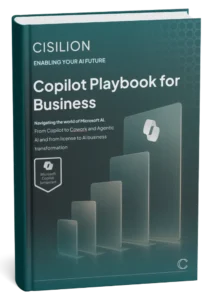
Microsoft’s AI landscape is evolving rapidly, from Copilot Chat and Microsoft 365 Copilot to specialist agents and autonomous AI orchestration.
Our Microsoft Copilot Playbook explores:
- How Microsoft’s AI ecosystem is evolving
- The role of Copilot, Agents and autonomous AI
- Why adoption should come before automation
- How to approach governance and cost management
- Practical examples of AI transformation in action
- How to build an AI-first operating model that delivers measurable outcomes
Download the Microsoft Copilot Playbook to understand how successful organisations are approaching AI adoption, governance and long-term transformation across the Microsoft ecosystem.
Key Questions IT Leaders Are Asking
Microsoft Copilot is designed to support users with tasks such as drafting, summarising, researching and analysing information. AI agents are designed to perform specific, repeatable activities that can be used consistently across teams and business processes.
Adoption helps employees build confidence, establish effective ways of working and identify valuable use cases before introducing more advanced automation. Organisations that adopt this approach are often better positioned to scale AI successfully
An AI-first operating model combines different Microsoft AI capabilities, including conversational AI, embedded assistants, specialist agents and autonomous workflows, depending on the outcome required
Before deployment, organisations should review data governance, security controls, user readiness, permissions and business objectives to ensure they can achieve sustainable value from Microsoft AI investments.