
At Microsoft Cloud and AI Frontier Week, sovereign cloud was not framed as a product or a single environment. It was framed as a strategic choice.
The conversation has moved on from where data sits. It is now about how cloud environments are designed, connected and adapted over time.
At the centre of that conversation sits one principle.
Interoperability.
Why cloud strategy is being rethought
For years, cloud strategy has been shaped by one assumption. That consolidation into a single platform is the most efficient path.
That model is now being challenged.
Organisations are facing a different set of pressures:
- Evolving regulation across multiple regions
- Rising expectations around data control
- Increased scrutiny on dependency and risk
- A faster pace of innovation, particularly in AI
The result is a shift in mindset. Cloud strategy is no longer about picking a platform. It is about designing an environment that can adapt.
Sovereign cloud as a strategic design
Sovereign cloud is often interpreted as restriction. In practice, it is the opposite.
Done well, it gives organisations more options, not fewer.
It allows them to:
- Match workloads to the right environment
- Apply the right level of control where it is needed
- Maintain access to innovation across the wider ecosystem
- Adjust their approach as requirements evolve
This is why sovereign cloud is increasingly described as a design principle rather than a deployment model.
How sovereign cloud works in practice
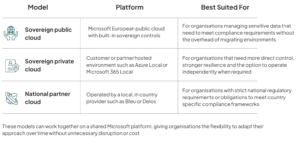
Sovereign cloud strategy is built across multiple environments, each serving a different purpose depending on risk, regulation and operational need.
These typically include:
- Public cloud with sovereign controls for scale and access to innovation
- Private or local cloud environments for sensitive workloads and operational autonomy
- Regionally governed partner environments where national requirements apply
The strength of this model is not the individual environments. It is how they work together.
Why these models only work when connected
Although each environment delivers value on its own, the real benefit comes from connecting them.
For example, organisations can run sensitive workloads in a private environment while still accessing AI services in a sovereign public cloud. Similarly, they can meet national regulatory requirements through a partner environment without losing access to wider innovation.
In short, the value lies in the architecture, not the individual platform.
Interoperability is the strategic anchor
Frontier Week made one point very clear.
The closer global systems come to tension, the more important interoperability becomes.
Interoperability is not just about technical compatibility. It is about preserving choice over time.
It allows organisations to:
- Move workloads between environments without major rework
- Shift suppliers or platforms when needed
- Respond to regulatory or geopolitical change quickly
- Avoid lock-in while still benefiting from scale
Without interoperability, sovereignty narrows options. With it, sovereignty expands them
The link between sovereignty and AI innovation
One of the most significant shifts highlighted during Frontier Week is the relationship between sovereignty and AI.
AI is moving fast. Access to the best models, tooling and platforms is now a competitive advantage.
Sovereignty cannot come at the cost of that access.
A modern sovereign strategy enables organisations to:
- Use advanced AI services within governed frameworks
- Control how and where data is used in training and inference
- Maintain transparency over model behaviour and outputs
- Apply consistent governance across environments
This is not about choosing between control and innovation. It is about designing for both.
What this means for cloud leaders
The implications of this shift are significant for technology leadership.
Cloud strategy now needs to address:
- Architecture flexibility across multiple environments
- Data and workload portability
- Governance frameworks that scale with growth
- Long term adaptability rather than short term optimisation
This is a more demanding conversation than “which cloud do we choose”.
It is closer to “how do we design a cloud strategy that holds up over the next decade”.
Speak to an Expert
Cloud strategy is being rewritten in real time.
The organisations that get ahead will be those that stop thinking about cloud as a single destination and start treating it as a connected, adaptable environment.
Interoperability is what makes that possible.
If you are reviewing your cloud strategy and want to understand how adaptable, interoperable and future-ready your environment really is, now is a useful moment to take stock.
Cisilion works with organisations to design cloud strategies that balance control, flexibility and long term innovation.
FAQ
Sovereign cloud is a cloud strategy designed to meet specific data, regulatory and governance requirements within a defined region or jurisdiction.
Traditional cloud strategy focuses on consolidation and scale. Sovereign cloud strategy adds control, governance and design flexibility across multiple environments.
It allows organisations to move workloads between environments, avoid dependency on a single provider and adapt quickly to change.
No, when designed correctly. It enables access to modern technologies, including AI, within a controlled and governed framework.
No. While it is critical for regulated sectors, the principles of control, flexibility and interoperability apply across all industries.