
Microsoft’s February 2026 Defender updates represent a clear shift in direction. This is not just incremental feature release. It is about unifying security operations, reducing analyst effort and bringing more intelligence into day‑to‑day cyber defence.
For security teams already under pressure from alert fatigue, skills shortages and growing attack surfaces, these changes matter.
Below, we break down the most important updates from a cybersecurity perspective and explain why they are relevant in real‑world SOC environments.
A stronger push towards unified security operations
One of the most significant developments is the continued consolidation of Microsoft security tooling into a single operational experience.
Microsoft Defender for Cloud is now expanding into the Microsoft Defender portal in public preview. From a security operations point of view, this matters because it reduces fragmentation between cloud posture management, threat detection and incident response.
For many organisations, cloud security signals live in one place while endpoint, identity and email alerts live somewhere else. That separation slows investigations and increases the risk of missed context.
Bringing Defender for Cloud visibility into the Defender portal is a clear step towards a more unified SOC workflow across cloud, identity, endpoint and code environments.
This direction also signals where Microsoft expects customers to operate long term. Security teams should be planning for a single pane of glass approach rather than managing multiple portals in parallel.
AI starts to move from promise to practical SOC use
AI has been a buzzword in security for years. What is changing now is how directly it is being embedded into operational workflows.
Two updates stand out here.
First, the AI‑driven playbook generation in Microsoft Sentinel. Security teams can now use a conversational interface to generate Python‑based SOAR playbooks. This lowers the barrier to automation significantly. For SOCs that struggle to maintain automation because of limited development skills, this is a meaningful shift.
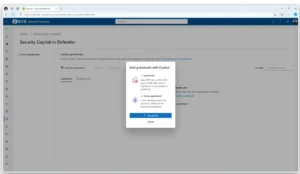
Second, the new Copilot Data Connector for Microsoft Sentinel allows Copilot audit logs and activity to be ingested into Sentinel and the Sentinel data lake. From a cyber risk perspective, this closes an important visibility gap. As Copilot adoption grows, understanding how it is being used, misused or abused becomes part of the security conversation. These logs can now feed detections, investigations and automation just like any other security signal.
Together, these updates show Microsoft moving AI beyond dashboards and into the mechanics of detection and response.
Behaviour‑based detection becomes easier to consume
One of the long‑standing challenges with SIEM platforms is signal overload. Analysts are often forced to manually correlate raw logs to understand attacker behaviour.
The general availability of the UEBA behaviours layer in Microsoft Sentinel directly addresses this. Instead of reviewing thousands of individual events, analysts are presented with summarised, human‑readable behaviours that explain who did what, when and to whom.
This is more than a usability improvement. Behavioural context helps analysts make faster, more confident decisions during investigations, particularly in identity‑led attacks where activity can appear legitimate when viewed in isolation.
Microsoft has also released a behaviours workbook as part of the UEBA essentials solution, giving SOC teams prebuilt views aligned to common workflows. This accelerates time to value, especially for teams that do not have the capacity to build custom workbooks from scratch.
Identity security remains a clear priority
Identity continues to be one of the most targeted attack surfaces and Microsoft’s updates reinforce that reality.
The newly available advanced hunting schema tables for Entra ID sign‑ins, service principal sign‑ins and Graph API audit events significantly improve identity‑level visibility. For threat hunters, this enables deeper analysis of authentication patterns, consent abuse and application misuse.
This focus is reinforced by Microsoft’s recent webinar on identity control plane attacks, highlighting techniques that bypass traditional phishing defences without breaking MFA. These are not theoretical risks. They are increasingly common in hybrid environments.
For organisations running Entra Connect Sync or Cloud Sync, Microsoft’s emphasis on treating identity synchronisation as a Tier‑0 asset is a reminder that identity infrastructure itself must be actively monitored and protected.
Operational improvements that reduce friction in incident response
Several updates are less headline‑grabbing but have real operational impact.
 Library Management for live response
 This addresses a long‑standing pain point in Defender for Endpoint. SOC teams can now centrally manage scripts and files outside of active incidents.
This improves response consistency and reduces delays during live investigations.
Effective Settings Reporting Security teams can now see the actual security configuration enforced on a device, not just the intended policy.
This helps identify configuration drift and enforcement failures, which are often exploited during real attacks.
Defender Vulnerability Management Clearer software component visibility and expanded coverage across older Windows versions improve risk prioritisation.
This is particularly relevant for organisations with legacy estates that cannot modernise overnight.
Preparing for change, not reacting to it
Microsoft has also provided clearer timelines and structural changes that security teams should plan for.
The extension of Microsoft Sentinel management in the Azure portal until March 31, 2027 gives organisations more breathing room, but it should not be mistaken for a long‑term strategy. The direction of travel is clear.
Similarly, upcoming standardisation changes to account naming conventions in Sentinel will impact analytics and automation. These are the types of changes that can quietly break detections if teams are not paying attention.
Security operations maturity increasingly depends on understanding platform roadmaps, not just responding to incidents.
What this means for organisations using Microsoft security tools
Taken together, these updates reflect three clear themes:
- Security operations are becoming more centralised and integrated
- AI is being applied directly to detection, automation and investigation
- Identity and behavioural context are critical to modern threat defence
For organisations already invested in Microsoft Defender and Sentinel, this is positive. But it also increases complexity.
More features do not automatically equal better security unless they are configured, monitored and operationalised correctly.
What this means in practice
Microsoft’s latest Defender updates show where modern security operations are heading. Greater consolidation across tools, more behavioural context, and increasing use of AI to support investigation and response.
What they also highlight is a familiar challenge for many organisations. As security platforms become more capable, they also become harder to run well day to day. New features, preview capabilities, configuration changes and evolving best practice all require time, expertise and ongoing attention.
This is particularly true for organisations that are already stretched. A unified platform only delivers value when signals are correctly integrated, detections are tuned, automation is governed and incidents are handled consistently.
At Cisilion, our managed services focus on helping organisations get lasting value from their Microsoft security investments. That means supporting security teams not just during incidents, but across the full operational lifecycle, from configuration and optimisation through to monitoring, response and continuous improvement.
The goal is not to add more tooling, but to make existing capabilities work harder and more effectively, so security teams can focus on reducing risk rather than keeping pace with change.
Talk to us about getting more from Microsoft security
A short conversation about how organisations are using Defender and Sentinel more effectively in day‑to‑day operations.