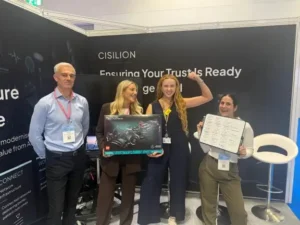
Last week Cisilion exhibited at HETT for the first time. We were on Stand G1 at ExCeL London on 29 and 30 September, right by the entrance, between the NHS Feature and the AI Zone. That’s a good spot if you’re talking about AI in healthcare. I’ll admit there was some pressure when the AI Zone was a few steps away.
The numbers
Here’s what two days at HETT looked like for us:
- 3,000+ healthcare professionals came to HETT this year, according to the organisers
- 186 badges scanned at our stand across the two days
- At one point there was a queue for the demo. I’m taking that as a career highlight.
Put another way, about one in every 16 people at the show stopped at our stand long enough to have their badge scanned.
Listening first, then showing
What struck me most was who came to talk to us. Many visitors were clinicians, not just people from digital and IT teams. That was the best thing that could have happened. They told us what really goes on: phone lines that are always busy, receptionists who never stop, and clinicians who spend time on admin that could go to patients.
I had a few ideas for how AI could help with that, so I built them into a working demo. To make it look real, I made a pretend GP practice called Ecofriendly GP Surgery, with its own website, phone number and web chat. Behind it sat Webex Contact Center, a Webex AI Agent and a small patient database. We showed three scenarios:
- “I’ve hurt my back.” A patient calls for advice. The AI Agent answers using its NHS knowledge source. When the patient asks to see someone, it picks a suitable clinician, books the appointment and sends an SMS confirmation. Nobody in the practice has to touch it.
- “I can’t make my appointment.” A patient calls to cancel. The AI Agent confirms who they are and removes the appointment from the system. That frees the slot for someone else instead of it becoming another missed appointment.
- “Can I get my test results?” The AI Agent isn’t allowed to talk about results, so it passes the call to a person. When the call reaches the clinician, the patient’s record opens on their screen, showing the latest test results and next appointment. The patient doesn’t have to explain everything again.
I also recorded all three as videos, because I wasn’t certain how good the exhibition WiFi would be and fully expected the hall to be too loud for a live voice demo. It’s good to plan for the worst. As it happens, the WiFi was pretty good, but it was certainly loud in there at times.
Interested in exploring AI in your organisation?
Start with our AI Readiness Assessment to understand your readiness across data, governance, infrastructure and people.